

Carbon Reduction Plan (PPN 006)
Effective Date: 24-October-2024
Updated: 22-May-2026
Introduction
This Carbon Reduction Plan has been developed in response to Procurement Policy Note (PPN) 006, which sets out the requirement for Logiq Consulting to manage greenhouse gas (GHG) emissions and demonstrate a commitment to achieving Net Zero emissions by 2050 in order to be eligible for Government contracts.
Logiq Consulting is committed to supporting Government Net Zero targets by 2050 and is taking all reasonable steps to achieve this before 2050. Logiq Consulting is committed to implementing this Carbon Reduction Plan and providing a wide range of carbon reduction initiatives in the delivery of contracts.
Emissions have been quantified following the PPN 006 Technical Standard and ISO 14064-1:2019, the international standard for the quantification and reporting of GHG emissions.
This Carbon Reduction Plan has been produced in collaboration with Carbonology® Ltd.
Commitment to Achieving Net Zero
Logiq Consulting is committed to achieving Net Zero emissions by 2050. This will be supported by the quantification of GHG emissions and development of a Carbon Reduction Plan in alignment with PPN 006 technical requirements on an annual basis.
The environmental measures outlined in this document will be applied in the delivery of relevant contracts, with a series of carbon reduction targets established to support progress towards Net Zero.
This document is a summary version of our full Carbon Reduction Plan that has been aligned to PPN 006 formatting guidelines for tender submission purposes.
Baseline Emissions Footprint: 2023
Baseline emissions represent the greenhouse gases produced in a defined base year, prior to the implementation of any emissions reduction strategies. They act as the reference point against which future emissions reductions are measured.
| Baseline year: 2023 (1st January – 31st December) | ||
| Additional details relating to the baseline emissions calculations: | ||
| This is the second year that Logiq Consulting have quantified organisational emissions. There have been multiple changes to the reporting boundaries since the previous reporting year, with the addition of emissions sources including electricity transmission & distribution, Exeter coworking, staff homeworking, rail travel, bus travel, air travel, hotel stays, upstream transportation, downstream transportation, servers, water supply and water treatment. The base year has been reset from 2022 to 2023 due to the wider scope of emissions reporting in 2023. Updating the baseline to 2023 ensures consistency and facilitates meaningful comparability of GHG emissions data in future reporting periods. Scope 3 categories refer to the GHG Protocol as referenced in PPN 006 guidance. | ||
| Baseline year emissions: | ||
| Emissions | Total (tCO2e) | |
| Scope 1 | 0.65 | |
| Scope 2 (location-based) | 4.61 | |
| Scope 2 (market-based) | 1.76 | |
| Scope 3 (included sources) Category 1: Purchased goods and services – 35.44 Category 2: Capital goods – 84.74 Category 3: Fuel and energy related activities – 35.39 Category 4: Upstream transportation and distribution – 0.24 Category 5: Waste generated in operations – 0.04 Category 6: Business travel – 165.96 Category 7: Commuting – 29.43 Category 8: Upstream leased assets – 0.53 Category 9: Downstream transportation and distribution – 0.15 | 351.93 | |
| Total emissions (location-based) | 357.19 | |
| Total emissions (market-based) | 354.34 | |
Previous Reporting Year: 2022
| Reporting year: 2022 (1st January – 31st December) | |
| Additional details relating to emissions calculations: | |
| 2022 was the first year that Logiq Consulting quantified organisational emissions to this level of detail. Scope 3 categories refer to the GHG Protocol as referenced in PPN 006 guidance. | |
| Emissions | TOTAL (tCO2e) |
| Scope 1 | 0.82 |
| Scope 2 (location-based) | 2.40 |
| Scope 3 (included sources) Category 1: Purchased goods and services – 40.84 Category 3: Fuel and energy related activities: – 40.26 Category 5: Waste generated in operations: – 0.61 Category 6: Business travel: – 27.61 Category 7: Commuting: – 49.70 | 159.02 |
| Total emissions (location-based) | 162.24 |
| Reporting year: 2024 (1st January – 31st December) | |
| Additional details relating to emissions calculations: | |
| The year 2024 was Logiq Consulting’s third period of emissions reporting. The range of Well-to-Tank (WTT) emission sources has been expanded, and emissions from purchased goods and services have been quantified for the first time. To avoid the need to update our baseline year, the 2024 figure for purchased goods and services has been used as a proxy for the 2023 reporting period. New WTT sources have been quantified retrospectively for 2023 to ensure continued annual comparability. Categories are from the GHG Protocol as referenced in PPN 006 guidance. | |
| Emissions | TOTAL (tCO2e) |
| Scope 1 | 2.66 |
| Scope 2 (location-based) | 4.75 |
| Scope 2 (market-based) | 2.62 |
| Scope 3 (included sources) Category 1: Purchased goods and services – 35.45 Category 2: Capital goods – 135.70 Category 3: Fuel and energy related activities – 52.79 Category 4: Upstream transportation and distribution – 0.21 Category 5: Waste generated in operations – 0.04 Category 6: Business travel – 262.17 Category 7: Commuting – 31.80 Category 8: Upstream leased assets – 0.65 Category 9: Downstream transportation and distribution – 0.29 | 519.09 |
| Total emissions (location-based) | 526.50 |
| Total emissions (market-based) | 524.37 |
Current Reporting Year: 2025
| Reporting year: 2025 (1st January – 31st December) | |
| Additional details relating to emissions calculations: | |
| The year 2025 was Logiq Consulting’s fourth period of emissions reporting. There were no changes to the reporting or organisational boundaries from the previous reporting period. Overall, total emissions decreased slightly compared to 2024, with a 4.00% reduction across both location-based and market-based totals. Categories are from the GHG Protocol as referenced in PPN 006 guidance. | |
| Emissions | TOTAL (tCO2e) |
| Scope 1 | 3.03 |
| Scope 2 (location-based) | 3.87 |
| Scope 2 (market-based) | 1.83 |
| Scope 3 (included sources) Category 1: Purchased goods and services – 40.67 Category 2: Capital goods – 124.22 Category 3: Fuel and energy related activities – 55.66 Category 4: Upstream transportation and distribution – 0.34 Category 5: Waste generated in operations – 0.04 Category 6: Business travel – 244.20 Category 7: Commuting – 30.22 Category 8: Upstream leased assets – 0.48 Category 9: Downstream transportation and distribution – 2.72 | 498.55 |
| Total emissions (location-based) | 505.45 |
| Total emissions (market-based) | 503.41 |
Emissions reduction targets
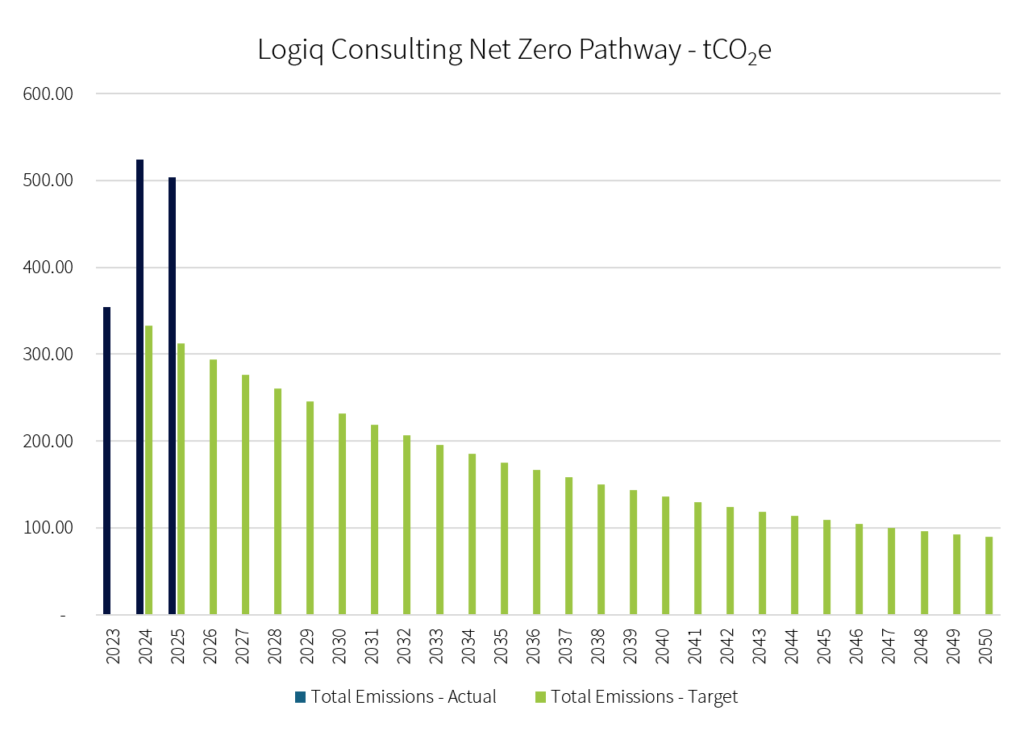
Below is a summary of our carbon reduction targets and forecasted results. To support continued progress towards Net Zero, we have adopted the following targets, with savings measured against the 2023 base year:
- Business travel and commuting: Reduce emissions by 8% per year
- 73.38 tCO2e saving by 2030
- Homeworking: Reduce emissions by 8% per year
- 13.01 tCO2e saving by 2030
- Capital goods: Reduce emissions by 5% per year
- 25.56 tCO2e saving by 2030
- Purchased goods and services: Reduce emissions by 5% per year. This will be dependent on the decarbonisation progress of our suppliers and the implementation of our own sustainable procurement policy.
- 10.68 tCO2e saving by 2030
Based on these targets, we project that carbon emissions will decrease over the next five years to 231.69 tCO2e by 2030. This is a reduction of 34.61% from the 2023 base year.
Progress against these targets can be seen in the graph below:
Carbon reduction projects
Completed Carbon Reduction Initiatives
- Emissions Monitoring System created to track GHG performance.
- Virtual meetings used where possible to reduce business travel.
- Hybrid working implemented company-wide to reduce emissions from commuting.
- Full staff homeworking survey completed to effectively estimate emissions.
- Methodology for capturing activity data improved and the scope of emissions reporting expanded.
- Introduced an EV salary sacrifice scheme.
In the future we hope to implement further measures such as:
- Transfer Corporate Energy Supply to 100% renewable tariff for site electricity in the near future.
- Implement a company-wide education campaign to engage interest and promote behavioural change including promoting the benefits of EVs, car sharing and developing ideas to save energy for homeworkers.
- Incorporate questions into future interviews to articulate Logiq’s commitment to achieving Net Zero emissions and to collect information regarding potential employee involvement in sustainability initiatives.
- Assessment of supply chain and a programme to reduce impact on the environment and work with Carbon Neutral suppliers where possible for supply of equipment and services.
- Internal events team to incorporate activities into team events such as Beach Clean and Litter Pick Up.
- Align our ESG goals to work with local enterprises with offsetting schemes, such as ‘Plant a Tree’.
- Change office lighting to energy saving motion sensor lights where possible. Explore options for insulation and solar panels, negotiating as part of new lease agreements where possible.
- Explore recycling schemes and utilisation of refurbished equipment. Move to purchase carbon-efficient laptops to reduce lifecycle emissions.
Declaration and sign off
This Carbon Reduction Plan has been completed in accordance with PPN 006 and associated guidance and reporting standard for Carbon Reduction Plans.
Emissions have been reported and recorded in accordance with the published reporting standard for Carbon Reduction Plans and the GHG Protocol Corporate Standard and uses the appropriate Government emission conversion factors for greenhouse gas company reporting
Scope 1 and Scope 2 emissions have been reported in accordance with SECR requirements, and the required subset of Scope 3 emissions have been reported in accordance with the published reporting standard for Carbon Reduction Plans and the Corporate Value Chain (Scope 3) Standard
This Carbon Reduction Plan has been reviewed and signed off by the board of directors (or equivalent management body).
Signed on behalf of the supplier:
Name: James Morgan
Position: CEO
Date: 22nd May 2026