
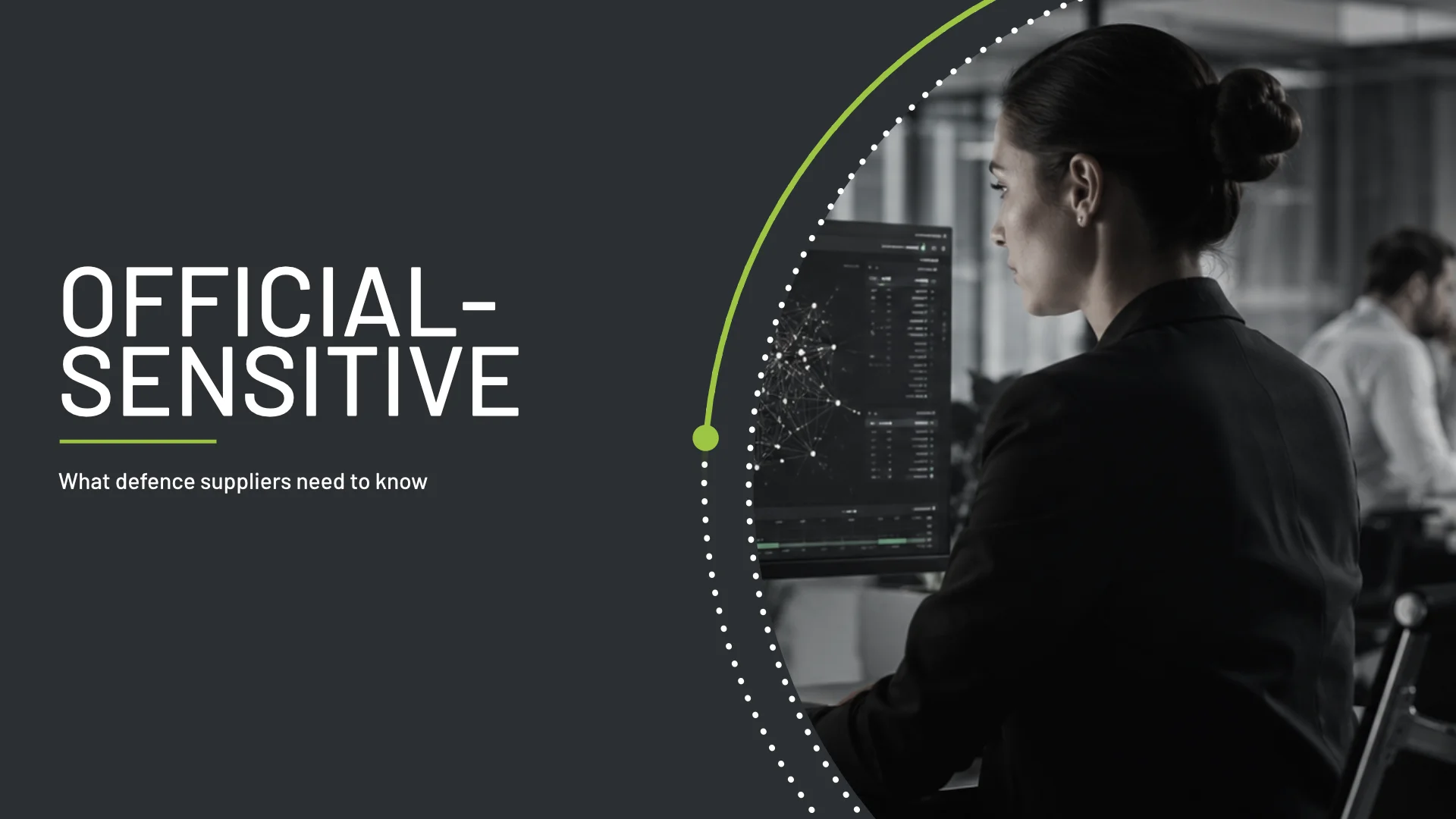
For organisations working with the Ministry of Defence, OFFICIAL and OFFICIAL-SENSITIVE are not just labels on documents. They shape how information is shared, who can access it, how it is stored, and what level of assurance may be expected from the working environment around it.
The confusion usually starts with the wording. OFFICIAL-SENSITIVE can sound like a separate classification, but under the Government Security Classifications Policy it sits within the OFFICIAL tier. The -SENSITIVE marking is applied where information needs tighter handling because compromise could have more damaging consequences than routine OFFICIAL material.
That distinction matters. A supplier that treats OFFICIAL-SENSITIVE material as ordinary business information may create unnecessary risk. A supplier that treats all OFFICIAL information as if it were SECRET may create unnecessary complexity. The practical answer sits somewhere in the middle: apply proportionate controls, understand the contractual context, and make sure people can show how sensitive work is being handled.
What does OFFICIAL mean?
OFFICIAL is the default classification for most government information. It covers a wide range of material, from information already cleared for release through to routine operational, policy or service information that is not intended for publication but is unlikely to be of particular interest to threat actors.
That does not mean OFFICIAL information can be handled casually. The need-to-know principle still applies. Access should be no wider than necessary for business needs, and the information creator should consider the sensitivity of the content, the recipient, and the consequences of loss or incorrect disclosure. In simple terms, OFFICIAL information still needs care. It just does not usually need the additional controls associated with the -SENSITIVE marking.
What does OFFICIAL-SENSITIVE mean?
OFFICIAL-SENSITIVE is used for OFFICIAL information that is not intended for public release and is of at least some interest to threat actors, activists or the media. A compromise could cause moderate short-term damage to HMG, the UK economy, international relationships, partner confidence, or harm and distress to individuals or groups.
In defence, this can include programme information, operational details, supplier information, technical outputs, controlled documentation, sensitive project correspondence, or material defined in a Security Aspects Letter. The exact scope should be driven by the contract, the information owner, the Security Aspects Letter where one exists, and local policy.
The important point is that OFFICIAL-SENSITIVE is not a decorative marking. It should change the way the information is handled. Access should be tighter. Sharing should be more deliberate. Marking should be clear. The environment used to store and process the information should be appropriate to the sensitivity of the work.
What changes in practice?
The main change is the balance between need-to-share and need-to-know. Routine OFFICIAL information can usually be shared more freely across organisations and partners where there is a valid business reason. OFFICIAL-SENSITIVE material requires a narrower view. It can still be shared, but the circle of access should be limited to those who genuinely need it, and any additional handling instructions should be followed.
For electronic information, that means thinking beyond the email subject line. Where OFFICIAL-SENSITIVE information is stored in shared areas, users should be confident that everyone with access to that folder or workspace has a legitimate need-to-know. Multiple uncontrolled copies should be avoided where possible. Documents and emails should carry appropriate markings, including any handling instruction that affects onward sharing.
For meetings and discussions, OFFICIAL-SENSITIVE material should not be discussed where it can be overheard. For hard copy material, copies should be kept to what is required, stored securely when unattended, and disposed of through an approved route. These are not exotic controls. They are the basics of disciplined information handling.
Why this matters for defence suppliers
Many suppliers do not struggle because they lack a policy document. They struggle because delivery is messy. Teams need to work with MOD stakeholders, subcontractors, engineering teams, project managers and commercial partners, often under pressure. Information moves across email, Teams, shared folders, portals, endpoints and supplier networks. Without a controlled operating model, OFFICIAL-SENSITIVE work can quickly become fragmented.
That is where the distinction becomes commercially important. If a contract involves MOD Identifiable Information, or if a Security Aspects Letter defines material as UK OFFICIAL-SENSITIVE, the supplier needs more than a general-purpose collaboration setup. They need a working environment where access, device posture, data sharing, logging, monitoring and governance can be explained and evidenced.
This also connects directly to wider MOD assurance expectations. DEFCON 658, the Cyber Security Model, Def Stan 05-138 Issue 4 and Secure by Design all point towards the same practical issue: suppliers need to understand how sensitive information is protected throughout delivery, not just at the point of contract signature.
How Logiq can help
Logiq supports organisations that need to handle sensitive information in defence, government and other regulated environments. DISX Secure Collaboration provides a managed, sovereign collaboration environment designed for organisations working with sensitive information, including OFFICIAL-SENSITIVE use cases where the configuration, operating model and customer requirements support that need.
For organisations still defining their approach, Logiq can also support the assurance work around information handling, Secure by Design, CSMv4 readiness and the design of secure operating models. The aim is not to make collaboration harder. It is to give teams a controlled way to work without leaving sensitive information scattered across unsuitable systems.
Serious handling, stronger control
OFFICIAL-SENSITIVE is not a separate classification tier, but it is a serious handling signal. It tells the organisation that the information needs stronger control than routine OFFICIAL material. For defence suppliers, the question is not simply whether a document is marked correctly. The better question is whether the people, systems and processes around that document can protect it in practice.
Related Links: