
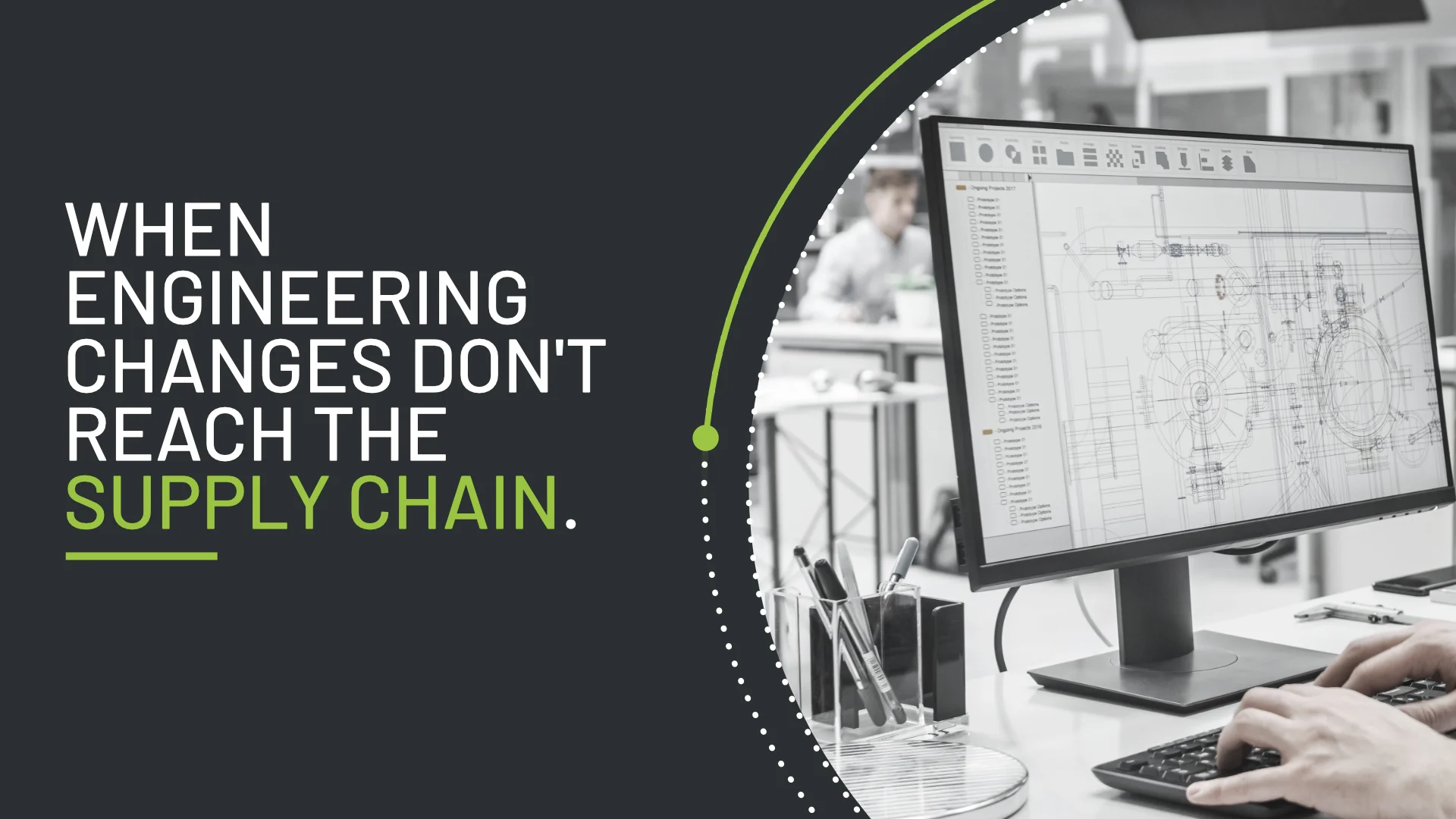
Engineering change is a normal part of defence manufacturing. Designs mature, requirements evolve, components become unavailable, production issues emerge, and customer needs shift as a programme progresses. A change may begin as a technical adjustment, but its effects rarely stay confined to engineering. A revised drawing can affect work instructions, inspection criteria, supplier activity, production schedules, procurement decisions, quality evidence and downstream assembly. The change itself may be relatively small. The challenge is making sure every affected party receives, understands and acts on the updated information at the right time.
Change rarely stays within engineering
Inside a single organisation, engineering change processes are usually well defined. Changes are reviewed, approved, recorded and issued through established routes. Most manufacturers supporting defence programmes have formal controls for managing revisions and maintaining traceability. Those controls are essential, but they are also easier to maintain when teams operate within a common set of systems and processes. The difficulty increases when a change needs to travel across organisational boundaries into a wider supplier network.
A change that appears straightforward inside the originating organisation can become much harder to manage once it affects suppliers, subcontractors or manufacturing partners. A revised component drawing may require updates to supplier instructions, inspection criteria, procurement information and production planning. If those updates do not move together, different parts of the supply chain may interpret the change at different speeds. That creates uncertainty not because the change was poorly conceived, but because its distribution becomes difficult to control once several organisations are involved.
Where engineering change starts to drift
A supplier may receive an updated drawing but not the supporting documentation that explains the reason for the change. Another supplier may receive the update after work has already started against the previous revision. A quality team may update inspection documentation while production teams continue working from earlier instructions. A programme team may assume that information has been distributed across the supply chain when only part of the supplier base has received it. These situations do not require a dramatic failure. They are the predictable result of information moving through multiple routes, across multiple organisations, under delivery pressure.
The difficulty is that email, shared repositories, customer portals and supplier systems each create their own version of the information trail. A document may be current in one environment and outdated in another. A notification may reach the right organisation but not the right individual. A change may be acknowledged by a supplier’s commercial contact while the production team continues working from an earlier local copy. None of this is unusual in a busy manufacturing programme, but it weakens confidence that the entire supply chain is moving together.
The cost of inconsistent change adoption
The consequences are rarely immediate in a clean and obvious way. More often, they appear later as uncertainty, delay or additional effort. Teams spend time checking which revision was available when work was performed. Suppliers ask for clarification because the status of a change is unclear. Quality teams investigate discrepancies between production records and current specifications. Engineering teams become involved in queries that are less about the technical change itself and more about whether the right information reached the right people. By the time a discrepancy is identified, the work required to understand and correct it can be far greater than the work required to issue the change in the first place.
The operational impact can also be significant. If a supplier continues manufacturing from a previous drawing revision, components may arrive out of tolerance or require rework. If quality documentation is not updated in line with the engineering change, inspection activity may be based on the wrong criteria. If production planning is not aligned to the updated requirement, schedules may need to be revised. Each of these issues has a cost in time, confidence and programme momentum. In defence manufacturing, where assurance, traceability and delivery performance all matter, avoidable inconsistency creates problems beyond simple document control.
Why speed does not guarantee consistency
The challenge is made more complex by the increasing digitalisation of manufacturing. Digital engineering, connected production systems, supplier integration and Industry 4.0 initiatives have improved the speed at which information can be created and distributed. That speed is valuable, but it does not automatically guarantee consistency. Faster information movement can still create confusion if suppliers and internal teams are not working from the same controlled source. A change that reaches one part of the supply chain quickly but another part late can still create divergence.
This is particularly important in a tiered supply chain. A principal manufacturer may have strong internal controls, but those controls do not automatically extend to every supplier, subcontractor or specialist partner involved in delivery. Each external organisation has its own systems, document practices, production priorities and internal communication routes. Even when a change is issued correctly by the originating organisation, there is still a question of how it is received, stored, distributed and acted upon elsewhere. The further information travels from its source, the harder it becomes to maintain confidence that everyone is working from the same approved position.
Maintaining control across the wider supply chain
Effective engineering change management depends on more than approval workflows. It depends on visibility across the full lifecycle of the change. Organisations need to understand which information is current, who has access to it, where it has been shared, and whether outdated versions remain in circulation. They also need practical routes for suppliers to access controlled information without defaulting to ad hoc file sharing or locally retained copies. Without that, the organisation may have a strong engineering change process internally but a weaker picture of how that change behaves once it enters the wider supply chain.
The point is not to remove change from manufacturing. That would be unrealistic and undesirable. The point is to reduce the uncertainty that follows change when information is distributed across too many routes and too many uncontrolled locations. Defence manufacturers that can maintain a clearer line between approved information, supplier access and programme collaboration are better placed to reduce rework, support quality assurance and maintain confidence across the supply chain. DISX Secure Collaboration is relevant here because it addresses the collaboration layer around engineering information. By providing a single, controlled environment for sharing drawings, specifications, change documentation and supporting project information with suppliers and internal teams, it helps reduce the reliance on scattered distribution routes and gives organisations a clearer basis for managing access, visibility and version consistency across defence programmes.
Related Links: